How does an AI voice system work?
Artificial intelligence is transforming communication, enabling applications such as:
- Voice bots
- Virtual assistants
- Conversational AI systems
- Automated contact centers
- Intelligent voice services
Modern AI voice services rely on VoIP telephony and operate through IP networks. This means voice is converted into data packets and transmitted through internet-based data transmission.
Each interaction includes:
- Voice capture
- Transmission over the network
- AI processing
- Response delivery
This means the first stages of communication define the overall user experience. Telephony forms the foundation of modern AI voice systems.
Why VoIP infrastructure is the foundation
For a conversation to feel natural and effective, several conditions must be met:
- Clean voice transmission
- Low-latency communication
- Minimal packet loss
- Stable routing
Research shows that:
- Packet loss below 1% ensures high voice quality
- Packet loss close to 3% already causes noticeable degradation
The amount of data exchanged during each call session directly affects both voice quality and response times.
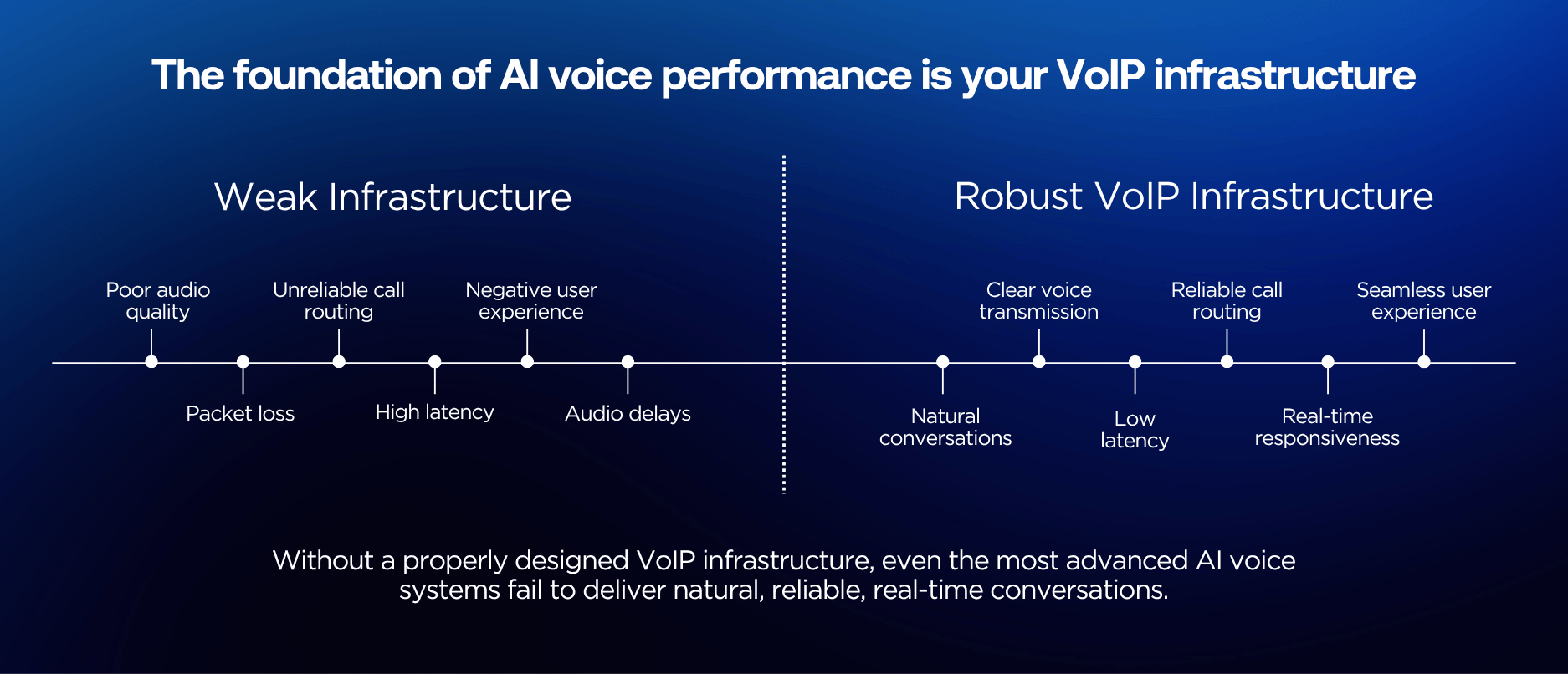
The overall performance of an AI voice system is directly tied to the quality of the VoIP infrastructure. If these factors are not properly optimized, users experience delays, interruptions, and poor communication quality regardless of how advanced the AI technology may be.
What is latency in VoIP telephony?
Latency refers to the delay between speaking and receiving a response in a real-time communication system.
Indicatively:
- Below 150 ms (oneway) → natural conversation
- 70–100 ms (oneway) → ideal experience
- Above 300 ms (oneway) → poor communication experience
Even small delays can disrupt conversational flow, create overlaps, and reduce user trust in the system.
Latency is affected by:
- Voice routing quality (referring to the multiple carriers involved in routing a call)
- The packetization settings configured for the selected codecs
- Network conditions (latency, jitter, and packet loss)
- Geographic distance
- Network congestion
- AI model processing
- Unstable Wi-Fi connections
In environments such as customer support, or long-distance communication, delays become immediately noticeable to end users.
When the problem is not the AI
Many people assume performance problems are caused by the AI system itself.
Users may notice:
- Delays during phone calls
- Poor audio quality
- Unnatural responses
- Conversation interruptions
- Reduced customer support performance
However, the root cause is usually network-related:
- Latency
- Routing
- Network congestion
- Packet loss
- The quality and connectivity of our provider with other carriers.
The result is a system that appears ineffective, while the actual bottleneck lies in the VoIP infrastructure.
A powerful AI model alone is not enough.
The importance of architecture in VoIP infrastructure
In cloud-based environments, maintaining consistent voice quality across distributed systems becomes even more critical.
To achieve high performance, a properly designed VoIP infrastructure is required, including:
- Intelligent routing (low-latency paths, traffic shaping and traffic engineering)
- High-quality VoIP (QoS and jitter control)
- Geographic proximity (edge infrastructure and participation in Internet Exchanges)
- Real-time network monitoring and instant failover (using BGP and BFD)
Research also shows that additional security layers can affect latency:
In the past, there was a common perception that encryption significantly increased latency in voice communications. In reality, modern IP phones, softphones, and network devices leverage hardware acceleration for cryptographic operations, making the performance overhead typically negligible and often less than 1 ms.
Similarly, TLS is used to secure SIP signaling rather than the audio stream itself. Any additional delay is primarily associated with the call setup process and is usually limited to only a few milliseconds, without affecting voice quality or latency during the actual conversation.
VPNs can introduce additional latency depending on network routing, tunnel configuration, and the underlying infrastructure. However, in cloud-native telephony platforms such as modulus, a VPN is not required for the normal operation of VoIP services. As a result, this potential overhead is typically not a factor for end users.
Why infrastructure matters? For this reason, choosing a provider with a modern cloud-native architecture, strong network interconnections, and carrier-grade infrastructure can have a significant impact on the quality, availability, and reliability of business communications.
Learn more about AI voice integrations.
The invisible power of infrastructure
While intelligent services are visible to users, infrastructure operates behind the scenes. But infrastructure is what makes the difference. Users primarily perceive voice quality and latency, not the underlying system itself. VoIP infrastructure enables voice systems to perform naturally, reliably, and at scale.
The future of AI voice services depends not only on the evolution of artificial intelligence models, but equally on the quality of the infrastructure supporting them. In practice, performance does not start with AI, it starts with telephony.
Without a properly designed VoIP infrastructure, no voice service can perform as intended.
It is no coincidence that AI voice technologies are now becoming a key part of digital transformation strategies, with the recent collaboration between the Greek government and ElevenLabs serving as a characteristic example. In this context, the integration between modulus and ElevenLabs combines advanced AI voice capabilities with carrier-grade VoIP infrastructure for reliable real-time communication.
However, no matter how advanced AI voice models become, the actual performance of an AI voice system still depends on something fundamental: the stability, quality and low latency of the telecommunications infrastructure supporting real-time communication.